
Smartstarter projects use an all-or-nothing model driven by smart contracts – connecting backers with their supporters.
Rewards like NFTs, physical goods, or acknowledgments may be offered but are not guaranteed.
If the funding goal isn’t reached in time, all contributions are automatically refunded to backers.
Details
📖 Detailed Story
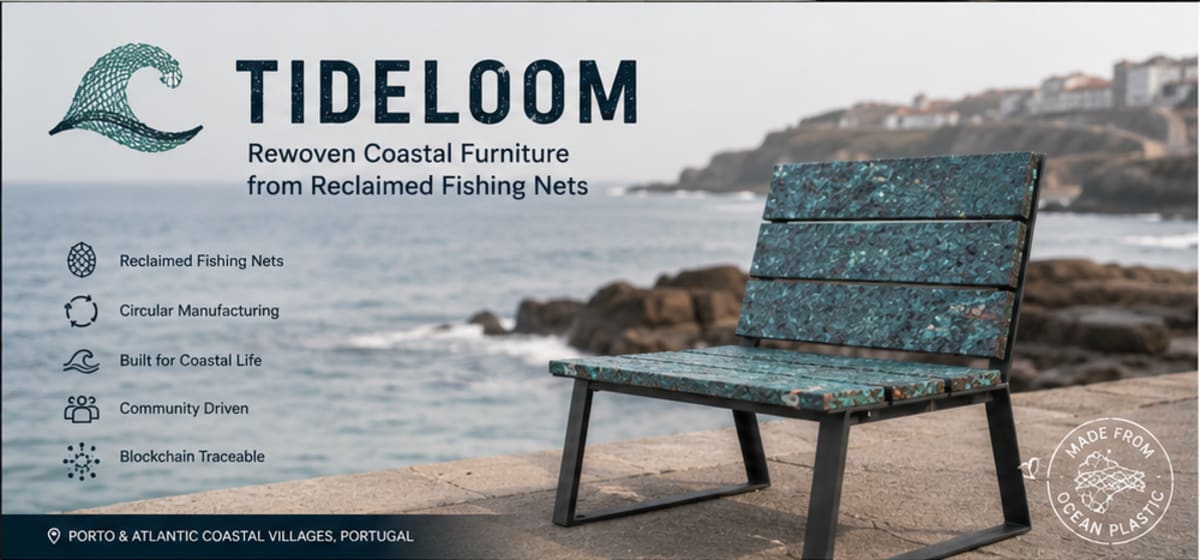
Every year, abandoned fishing gear continues damaging marine ecosystems long after use. TIDELOOM transforms discarded nets into durable public furniture through decentralized coastal recycling workshops.
The system includes:
- Melt-pressed recycled panels
- Aluminum connector hardware
- Replaceable seat modules
- Flat-pack assembly design
- Community fabrication guides
Products are intended for:
- Public parks
- Coastal hostels
- Outdoor cafes
- Community spaces
- Eco-tourism projects
Each furniture unit includes traceable material records documenting where the recovered plastics originated.
🧪 Prototype Status
Completed:
- 12 bench prototypes
- Saltwater durability testing
- UV exposure testing
- Public pilot installations
- Recycled panel compression trials
💰 What Funding Enables
Item | Allocation |
Net collection logistics | ₳ 4,200 |
Recycling equipment upgrades | ₳ 6,000 |
Pilot furniture production | ₳ 5,500 |
Community workshop setup | ₳ 3,000 |
Material certification testing | ₳ 3,300 |
Risks & Challenges
Marine plastic quality varies significantly between collection sites. We mitigate through material sorting, blend testing, and standardized compression processing.

tideloom_clctv
We are TIDELOOM Collective, a small coastal materials studio based between Porto and the Atlantic fishing towns of northern Portugal. Our work focuses on transforming abandoned marine plastics, damaged fishing nets, and discarded harbor materials into durable public-use products with long lifecycle design principles. Our team combines industrial design, marine recovery operations, and decentralized recycling methods to create modular furniture systems that can be repaired, remade, and locally manufactured. We believe waste systems should become visible infrastructure — not hidden landfill streams. Alongside furniture production, we run cleanup collaborations with fishing communities and experiment with open material documentation for transparent circular manufacturing.